
Best Portable Power Station (2026): 4 Picks for Outages and Camping
Last updated: November 9, 2026
Reader-supported: we may earn a commission when you buy through links on this page, at no extra cost to you. It never affects our rankings. Learn more.
When the power goes out, a gas generator is loud, smelly and unsafe to run indoors. A portable power station is a big rechargeable battery with normal outlets: no fuel, no fumes and almost no noise. It can keep your Wi-Fi router, laptop, lights and a refrigerator running through an outage, and it comes with you on camping trips too.
We compared four of the best-reviewed models in the popular 1kWh to 2kWh range on capacity, output power, charging speed, battery life and weight. Here is what we recommend in 2026.
Our top picks
| Power station | Capacity and output | Score | Buy link |
|---|---|---|---|
| Jackery HomePower 1000 v2Best overall | 1,024Wh | 1,500W | 9.0 | Check price |
| Anker SOLIX C1000 Gen 2Fastest recharging | 1,024Wh | 2,000W | 9.0 | Check price |
| EcoFlow DELTA 3Best expandable | 1,024Wh | 1,800W | 8.8 | Check price |
| BLUETTI Elite 200 V2Best for home backup | 2,073.6Wh | 2,600W | 8.7 | Check price |
The best portable power stations, reviewed
Jackery HomePower 1000 v2

- Capacity1,024Wh
- AC output1,500W
- SwitchoverUnder 10 ms UPS
- RechargeFull in about 50 minutes
- Battery life6,000+ cycles
- NoiseUnder 30 dB
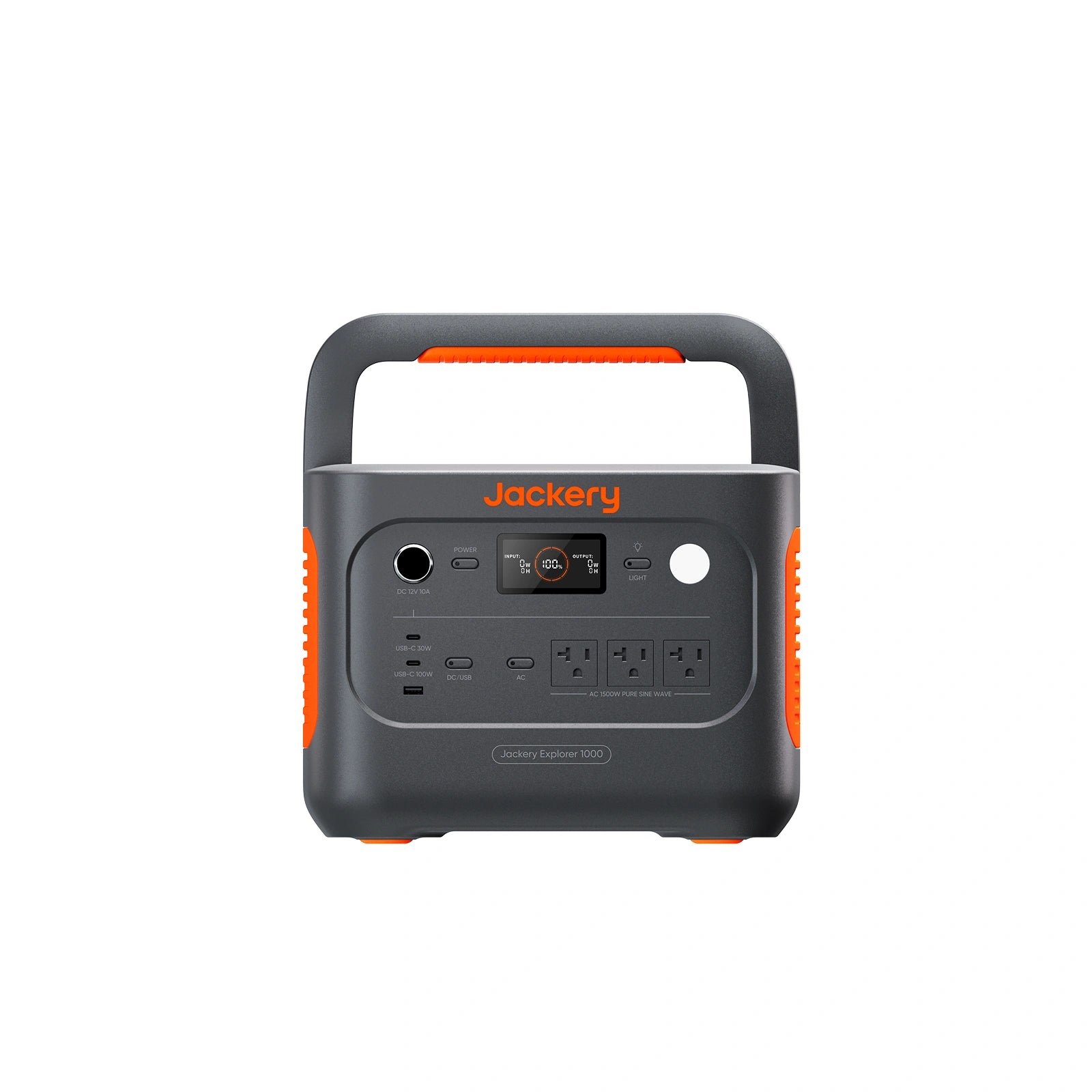
Jackery’s Explorer 1000 v2 is no longer sold on Jackery’s store, and the HomePower 1000 v2 takes its place. It stores 1,024Wh and puts out 1,500W, enough for a fridge, router, lights and phones during an outage.
It switches over in under 10 ms like a UPS, recharges fully in about 50 minutes and is rated for 6,000+ cycles. Priority Routing can switch off less important devices when the battery gets low, so your fridge and router stay on longer.
Jackery’s store listed it at $549 in November 2026.
What we like
- Fast 50-minute recharge
- Under 10 ms UPS switchover
- 6,000+ cycle battery
- Quiet under 30 dB
Watch out for
- 1,500W is lower than the Anker’s 2,000W
- Not expandable
- Weight not listed on Jackery’s page
Best for: Most homes that want quiet backup for essentials.
Skip it if: You need to run high-wattage appliances.
Check price on Amazon Price range: $549 at Jackery (Nov 2026)
Anker SOLIX C1000 Gen 2

- Capacity1,024Wh LiFePO4
- AC output2,000W (3,000W peak)
- Weight24.9 lb (11.3 kg)
- Recharge49 minutes with UltraFast mode (enabled in the app)
- Solar inputUp to 600W, about 1.8 hours
- SwitchoverUnder 10 ms
Anker’s C1000 Gen 2 is built around speed. With UltraFast charging switched on in the Anker app, it recharges from the wall at 1,600W in about 49 minutes, which Anker says is the fastest among portable power stations it compared as of April 2025. It also pushes out 2,000W continuously with a 3,000W peak, more than the Jackery, and it keeps at least 80% of its capacity after 4,000 charge cycles. Anker’s own FAQ notes that UltraFast charging only kicks in once the battery is above roughly 68 degrees Fahrenheit, and that you should use it only when needed to prolong battery life.
What we like
- Very fast recharging, 49 minutes in UltraFast mode
- 2,000W output with 3,000W peak
- Keeps at least 80% capacity after 4,000 cycles
- Accepts up to 600W of solar input
- Switches to battery in under 10 ms
Watch out for
- Cannot be expanded with extra batteries
- UltraFast charging needs the app and a warm battery
- Anker advises using UltraFast sparingly to protect battery life
Best for: People who want the quickest top-up before a storm and more output than the Jackery.
Skip it if: You want to grow your capacity later; Anker points expansion buyers to the older C1000.
Check price on Amazon Price range: $549.99 at Anker SOLIX (Nov 2026)
EcoFlow DELTA 3
- Capacity1,024Wh LiFePO4, expandable up to 5kWh
- AC output1,800W, X-Boost for higher resistive loads
- Weight27.6 lb (12.5 kg)
- RechargeAbout 56 minutes with AC plus solar
- Battery life4,000 cycles to 80% capacity
- SwitchoverUnder 10 ms
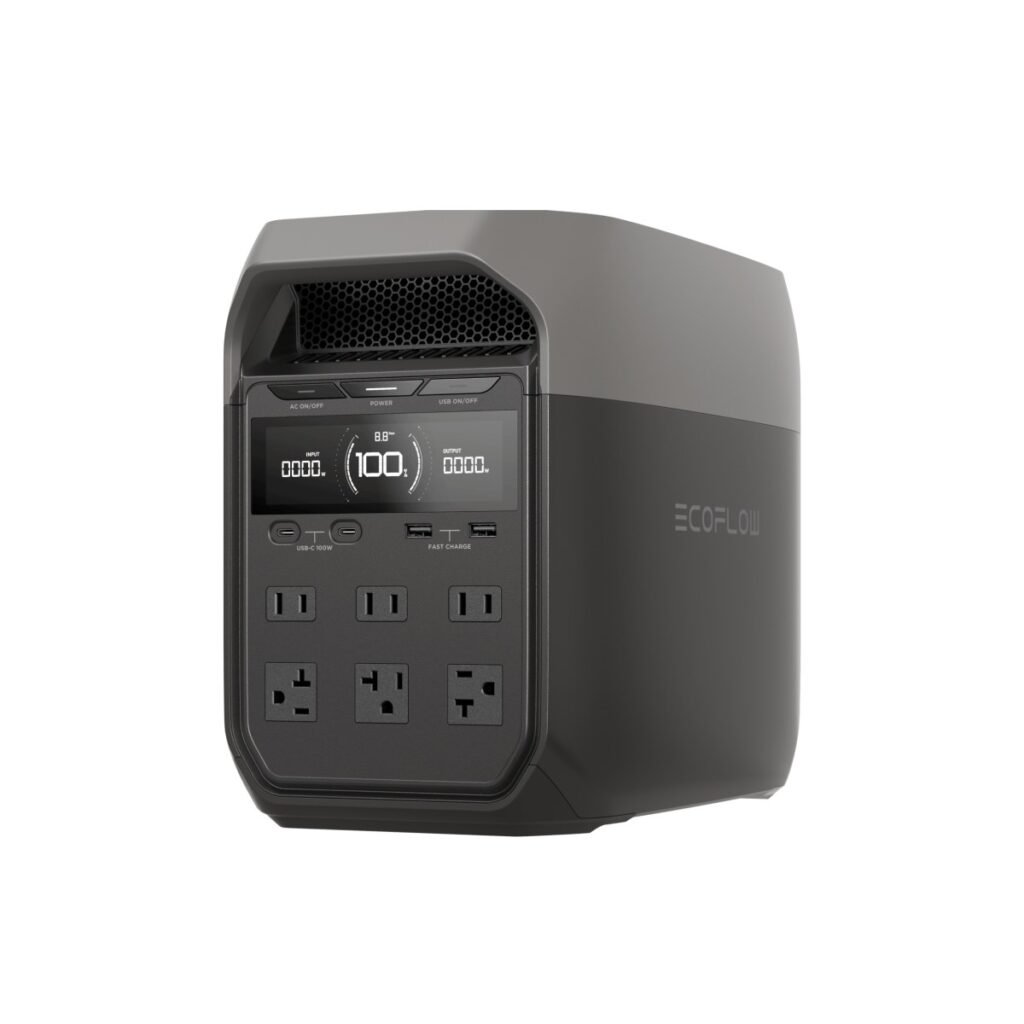
The DELTA 3 starts at 1,024Wh and grows with you. You can connect compatible EcoFlow DELTA 2 and DELTA 3 expansion batteries to reach up to 5kWh, which makes it a smart starting point if you may want whole-room backup later. It provides 1,800W of continuous AC output, and EcoFlow’s X-Boost mode lets it run resistive appliances that draw more than that. A full recharge takes about 56 minutes when you combine 1,500W of wall power with 500W of solar, and it offers around 13 output options. The trade-off is weight: at 27.6 pounds it is the heaviest of the 1kWh models here.
What we like
- Expandable up to 5kWh with compatible batteries
- 4,000 cycles to 80% capacity
- About an hour to recharge fully
- Switches to battery in under 10 ms
Watch out for
- Heaviest of the three 1kWh picks
- Expansion batteries are sold separately and add cost
- Fast charging needs wall power and solar together
Best for: Anyone who wants to start at 1kWh and add capacity as their backup needs grow.
Skip it if: You want the lightest unit for car camping or hiking.
Check price on Amazon Price range: $579 at EcoFlow (Nov 2026)
BLUETTI Elite 200 V2
- Capacity2,073.6Wh LiFePO4
- AC output2,600W (3,900W Power Lifting mode)
- Weight53.4 lb (24.2 kg)
- Recharge80% in about 1.1 hours, full in about 1.4 hours
- Solar inputUp to 1,000W
- Warranty5 years
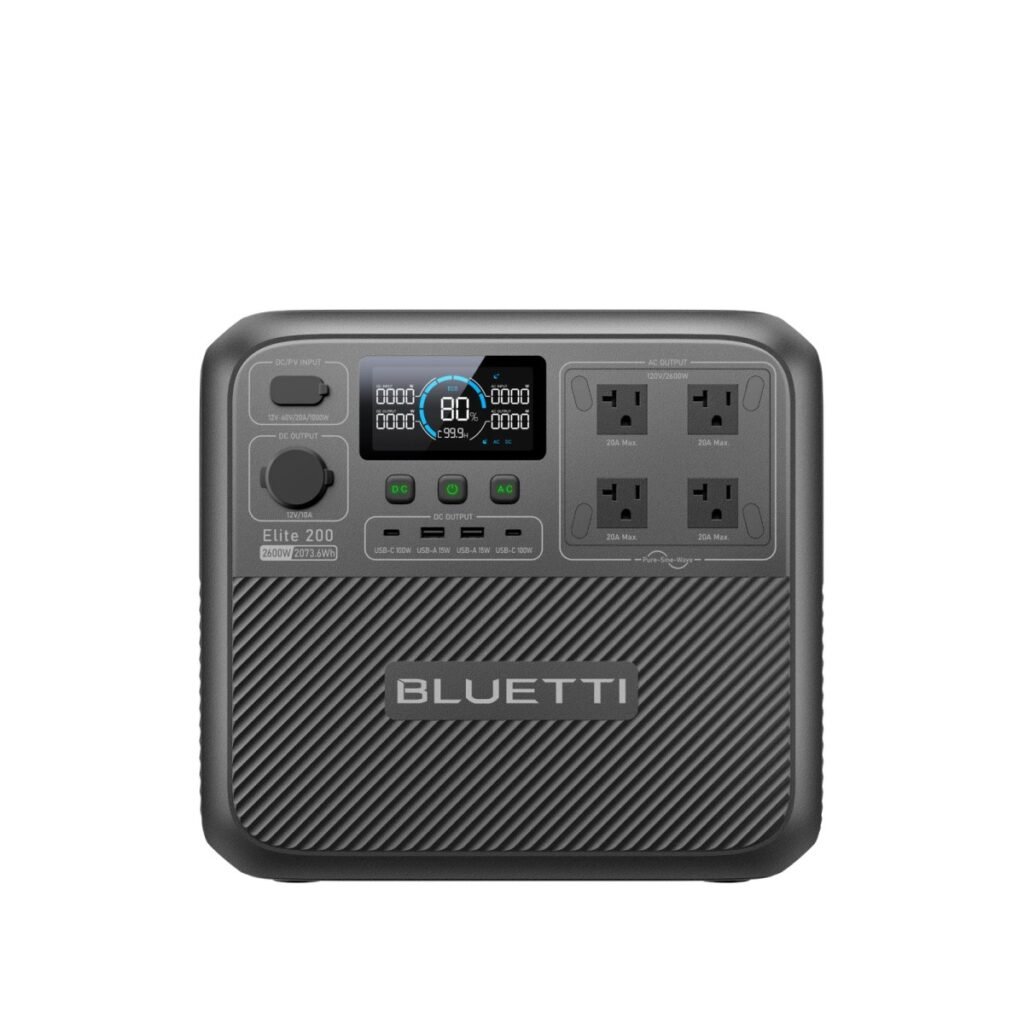
If you want to ride out a longer outage, the Elite 200 V2 gives you twice the stored energy of the 1kWh models. Its 2,073.6Wh battery and 2,600W output can run a refrigerator and several other essentials together, and its Power Lifting mode supports resistive loads such as kettles, electric blankets and hair dryers up to 3,900W. BLUETTI says it reaches 80% charge in about 1.1 hours using up to 1,800W of AC input, and it accepts up to 1,000W of solar. At low loads its fan runs as quietly as 16 decibels.
What we like
- Twice the capacity of the 1kWh models
- 2,600W output with 3,900W Power Lifting mode
- 80% charge in about 1.1 hours
- Up to 1,000W of solar input
- 5-year warranty
Watch out for
- Heavy at 53.4 lb for frequent carrying
- Highest price of the four
- Power Lifting works only for pure resistive loads
Best for: Home backup for a fridge, Wi-Fi and lights through outages lasting a day or more.
Skip it if: You will carry it often; the weight is a lot for camping trips.
Check price on Amazon Price range: $899 at BLUETTI (Nov 2026)
Side-by-side comparison
| Jackery HomePower 1000 v2 | Anker SOLIX C1000 Gen 2 | EcoFlow DELTA 3 | BLUETTI Elite 200 V2 | |
|---|---|---|---|---|
| Best for | Best overall | Fastest recharging | Best expandable | Best for home backup |
| Capacity | 1,024Wh | 1,024Wh | 1,024Wh (expandable to 5kWh) | 2,073.6Wh |
| AC output | 1,500W | 2,000W | 1,800W | 2,600W |
| Fast recharge | About 50 min | 49 min | About 56 min (AC + solar) | About 1.4 hours |
| UPS switchover | Under 10 ms | Under 10 ms | Under 10 ms | See BLUETTI |
| Price | $549 at Jackery (Nov 2026) | $549.99 at Anker SOLIX (Nov 2026) | $579 at EcoFlow (Nov 2026) | $899 at BLUETTI (Nov 2026) |
| Our score | 9.0 | 9.0 | 8.8 | 8.7 |
How to choose a portable power station
1. Match capacity (Wh) to what you want to run
Capacity is measured in watt-hours (Wh) and tells you how long the station can keep going. A handy rule of thumb: runtime in hours is roughly capacity x 0.85 divided by the device’s watts, because some energy is lost converting battery power to AC. A 100W device on a 1,000Wh station runs for about 8 to 9 hours.
- Around 1,000Wh: routers, laptops, lights, a TV and a refrigerator for about a day.
- Around 2,000Wh: the same essentials for longer, plus bigger loads for short bursts.
2. Check the output watts
Add up the watts of everything you want to run at the same time. If the total is higher than the station’s continuous AC output, it will shut off. Appliances with motors, such as refrigerators, briefly draw more power when they start, so look at the surge rating too. Boost modes like X-Boost and Power Lifting help only with simple heating appliances such as kettles and hair dryers.
3. Choose LiFePO4 batteries
All four picks use lithium iron phosphate (LiFePO4 or LFP) cells. They are safer and last far longer than older lithium-ion packs, with ratings of around 4,000 charge cycles. That works out to roughly a decade of daily use.
4. Compare charging speed and solar input
Fast wall charging matters when a storm is coming and you have an hour to top up. Solar input matters if an outage could last for days. Check the maximum solar wattage, because it decides how quickly panels can refill the battery. Solar panels are sold separately for all four models.
5. Know the limits
Portable power stations are great for essentials, but they are not a whole-house generator. Jackery, for example, advises against using its power stations with medical or life-support equipment, data servers or other equipment where a power cut could cause injury or serious damage. Charge and store your station within the temperature range in its manual. For Jackery that is 32 to 113 degrees Fahrenheit for charging.
Frequently asked questions
How long will a portable power station run a refrigerator?
A modern refrigerator typically uses roughly 1 to 2 kWh a day, so a station of around 1,000Wh can often keep one going for about a day, and a 2,000Wh unit for longer. Opening the door less and adding solar panels both stretch the runtime.
Can I use a portable power station indoors?
Yes. Unlike gas generators, they produce no exhaust fumes, so they can run inside the home. Keep the vents clear, keep the unit dry and away from heat sources, and follow the temperature limits in the manual.
Is a portable power station better than a gas generator?
For most households’ essentials, yes. They are quiet, fume-free and need no fuel. A gas generator can still make sense if you need to run many large appliances for days, since a battery has a fixed amount of stored energy.
Can solar panels recharge these power stations?
Yes. The maximum solar input is about 400W for the Jackery HomePower 1000 v2, 600W for the Anker C1000 Gen 2, 500W for the EcoFlow DELTA 3 and 1,000W for the BLUETTI Elite 200 V2. Panels are sold separately, and real-world output is usually lower than the rated wattage.
How long do portable power stations last?
LiFePO4 models like these are rated for about 4,000 charge cycles, and Anker and Jackery both describe that as roughly 10 years of daily use. Real life depends on how deeply you discharge it and how it is stored.
The bottom line
For most homes, the Jackery HomePower 1000 v2 is the best all-round portable power station: fast to recharge, quiet and easy to use. If speed and higher output matter most, choose the Anker SOLIX C1000 Gen 2. Planning to grow your system later? The EcoFlow DELTA 3 expands up to 5kWh. And for longer outages, the BLUETTI Elite 200 V2 offers twice the capacity.
Looking for more ways to keep your home powered? Browse all our Power Backup guides, or ask us a question.


