Best Indoor Air Quality Monitor (2026): 5 Top Picks
Last updated: November 8, 2026
Reader-supported: we may earn a commission when you buy through links on this page, at no extra cost to you. It never affects our rankings. Learn more.
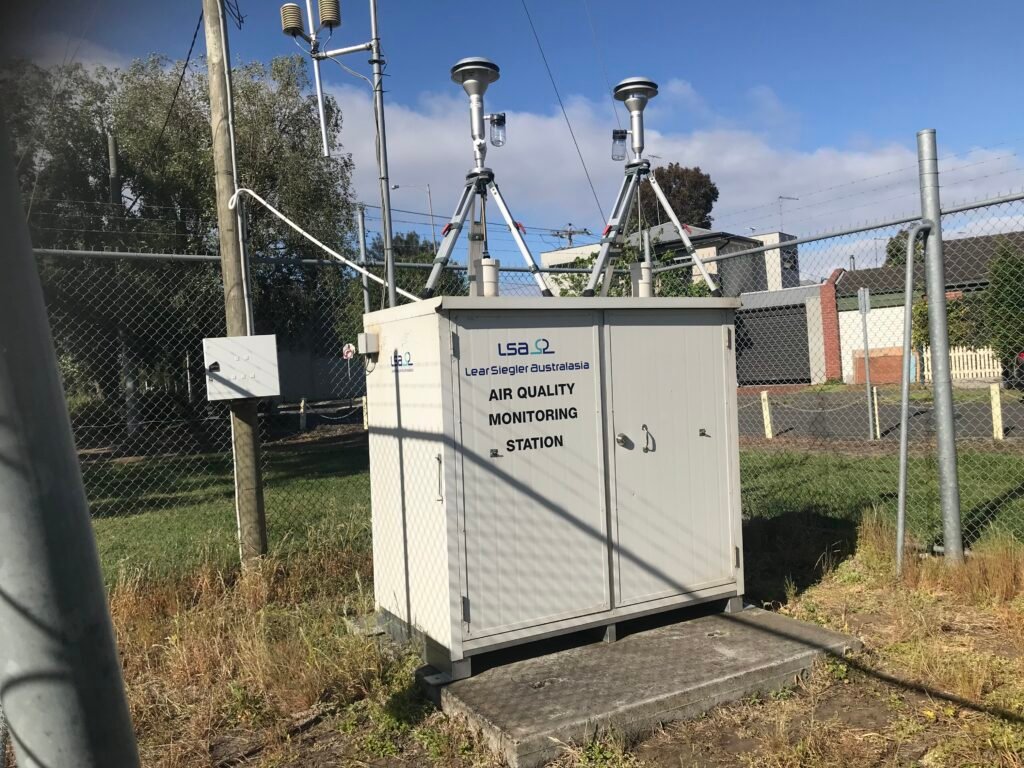
Indoor air can hold more pollution than the air outside: fine dust from cooking and wildfire smoke, carbon dioxide (CO2) that builds up in closed bedrooms, and chemical fumes (VOCs) from cleaning products, paint and new furniture. You cannot see most of it. The best indoor air quality monitor shows you what is in the air, so you know when to open a window, run the kitchen fan or switch on an air purifier.
We compared the most popular home air quality monitors on what they measure, sensor accuracy, ease of reading, app and smart-home features, and price. Here are our picks for 2026.
Our top picks
| Air quality monitor | Measures | Score | Buy link |
|---|---|---|---|
| Airthings View PlusBest overall | 7 readings incl. radon | 9 | Check price |
| Aranet4 HomeBest CO2 monitor | CO2, temp, humidity, pressure | 8.8 | Check price |
| IQAir AirVisual ProBest for smoke and fine dust | PM2.5, CO2, TVOC and more | 8.6 | Check price |
| Qingping Air Monitor 2Best value all-rounder | 7 readings, no radon | 8.4 | Check price |
| Airthings Wave MiniBest budget pick | VOCs, mold risk, temp, humidity | 8 | Check price |
The best indoor air quality monitors, reviewed
Airthings View Plus
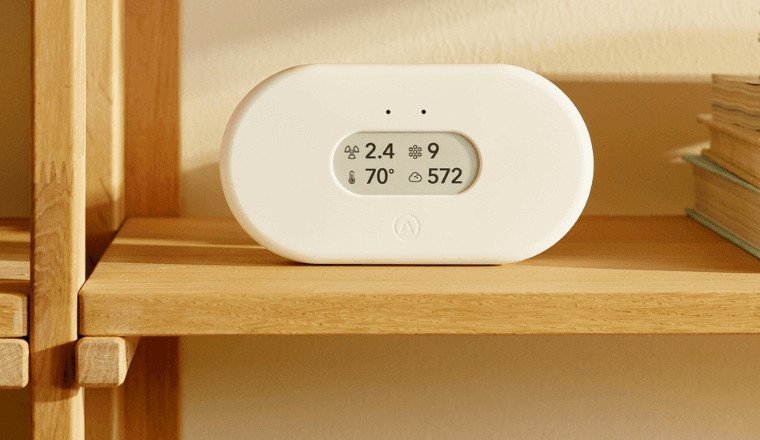
- MeasuresRadon, PM2.5, CO2, VOCs, humidity, temperature, air pressure
- Display2.9-inch e-ink screen with color glow indicator
- ConnectivityWi-Fi; works with Alexa, Google Assistant, IFTTT
- Power6 AA batteries (up to 2 years) or USB-C
- PlanNo subscription
The View Plus covers more than any other monitor here. It measures radon along with fine dust, CO2 and VOCs, so one device tracks the biggest indoor air risks.
It has seven sensors in all, plus an e-ink screen that is always on and a glow that turns green, yellow or red. It alerts at the EPA radon action level of 4 pCi/L.
It runs on six AA batteries for up to 2 years, or on USB-C power. It works with Alexa and Google Assistant. It costs $329.99 on Airthings’ site.
What we like
- Measures radon plus the major pollutants
- Always-on e-ink screen
- Battery or USB-C power
- Works with Alexa and Google
Watch out for
- Expensive
- Radon readings take days to settle
- VOC readings show trends, not exact levels
Best for: Homeowners who want one monitor for everything, including radon.
Skip it if: You only care about CO2.
Check price on Amazon Price range: $329.99
Aranet4 Home
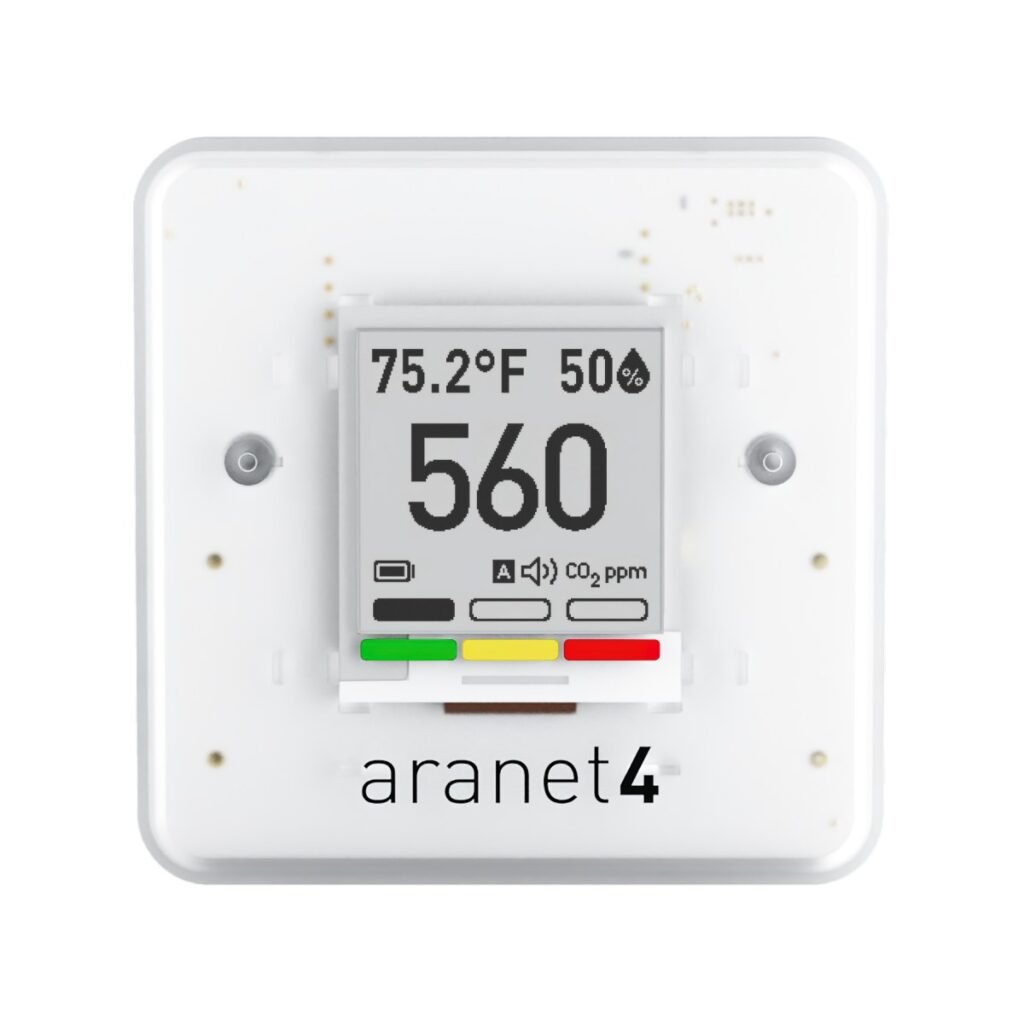
- MeasuresCO2 (NDIR sensor), temperature, humidity, air pressure
- CO2 accuracy±(30 ppm + 3% of reading)
- DisplayE-ink screen
- ConnectivityAranet Home app
- PowerBatteries, up to 4 years
- Warranty2 years (extendable to 3)
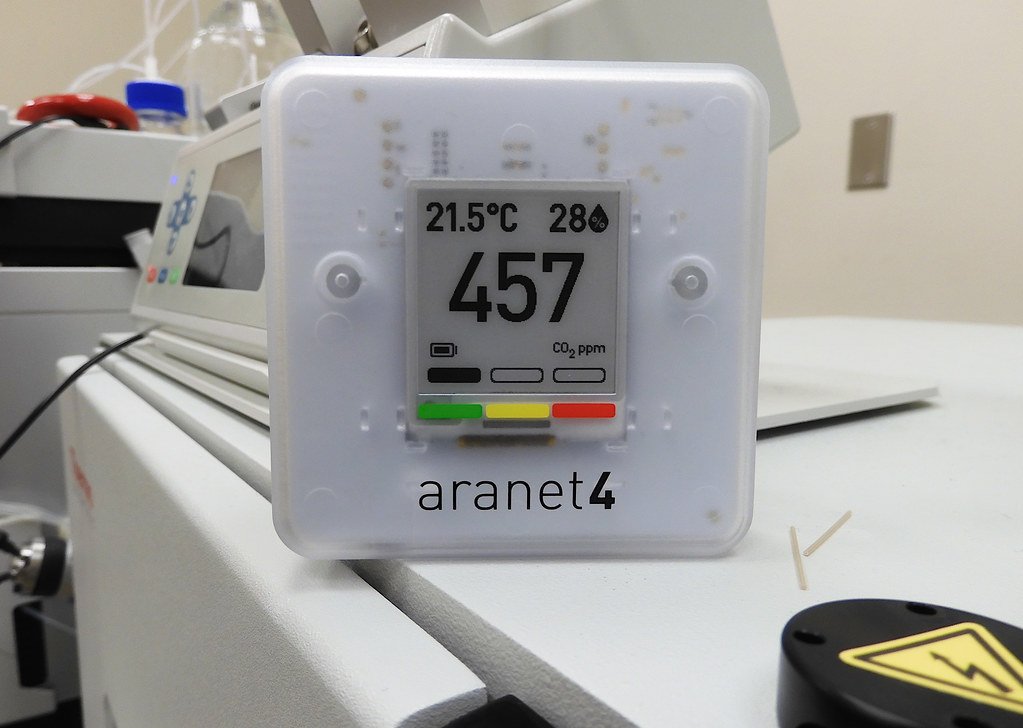
If you mainly want to know when a room is stuffy, the Aranet4 HOME is built for that. It uses a true NDIR CO2 sensor, and Aranet lists its accuracy as ±30 ppm plus 3% of the reading.
The e-ink screen is easy to read, and Aranet says the batteries last up to 4 years. The free app shows trends and alerts, with no subscription.
It does not measure dust or VOCs. Note that it measures carbon dioxide, not carbon monoxide. It costs $189 and has a 2-year warranty.
What we like
- Accurate NDIR CO2 sensor
- Readable e-ink screen
- Up to 4 years of battery
- No subscription
Watch out for
- No PM2.5 or VOC sensor
- Does not detect carbon monoxide
- Pricey for a CO2-focused monitor
Best for: Bedrooms, home offices and classrooms.
Skip it if: You need smoke or dust readings.
Check price on Amazon Price range: $189
IQAir AirVisual Pro
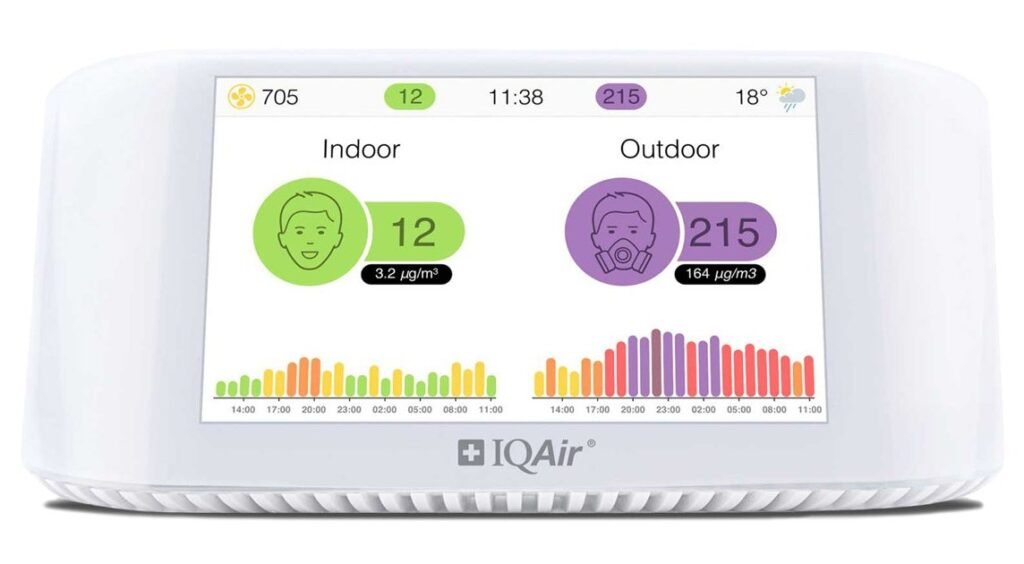
- MeasuresAQI, PM2.5, CO2, TVOC, temperature, humidity
- DisplayBuilt-in color screen with recent trends
- Connectivity2.4 GHz Wi-Fi or Power over Ethernet, IQAir AirVisual app
- AlertsCustom notifications in the app
- PlanNo subscription
IQAir is best known for its air purifiers, and the AirVisual Pro brings that focus to monitoring. It measures PM2.5 with a laser sensor, which matters during wildfire smoke or if someone at home has asthma.
Its color screen shows indoor readings next to local outdoor air quality, so you can see at a glance whether to keep the windows shut. It also tracks CO2 and total VOCs.
It connects over 2.4 GHz Wi-Fi or Power over Ethernet. It does not measure radon. It costs $329.99 on IQAir’s site.
What we like
- Laser PM2.5 sensor
- Clear color screen
- Indoor and outdoor comparison
- Wi-Fi or Ethernet
Watch out for
- No radon sensor
- Expensive
- Mainly meant to stay plugged in
Best for: Wildfire areas and asthma households.
Skip it if: You want a cheap, battery-powered monitor.
Check price on Amazon Price range: $329.99
Qingping Air Monitor 2

- MeasuresPM2.5, PM10, CO2, eTVOC, noise, temperature, humidity
- Display4-inch color touchscreen
- ConnectivityWi-Fi app; works with Xiaomi Home
- ExtrasReplaceable PM sensor, 24-hour and 30-day history
- PlanNo subscription
The Qingping Air Monitor 2 packs seven readings, including dust, CO2 and VOCs, into a compact device with a 4-inch touchscreen. Its readings refresh every second.
Its particle sensor can be replaced later. Tap the screen to see 24-hour or 30-day history, and colored lights show air quality at a glance.
It has no radon sensor, and its VOC reading is an estimate (eTVOC). Qingping does not list a US price on its own site, so check retailers.
What we like
- Seven readings in one device
- Bright touchscreen
- Replaceable particle sensor
- 24-hour and 30-day history
Watch out for
- No radon sensor
- VOC reading is an estimate
- App is less polished than Airthings
Best for: People who want a full picture without paying premium prices.
Skip it if: You need radon tracking.
Check price on Amazon Price range: See retailers
Airthings Wave Mini
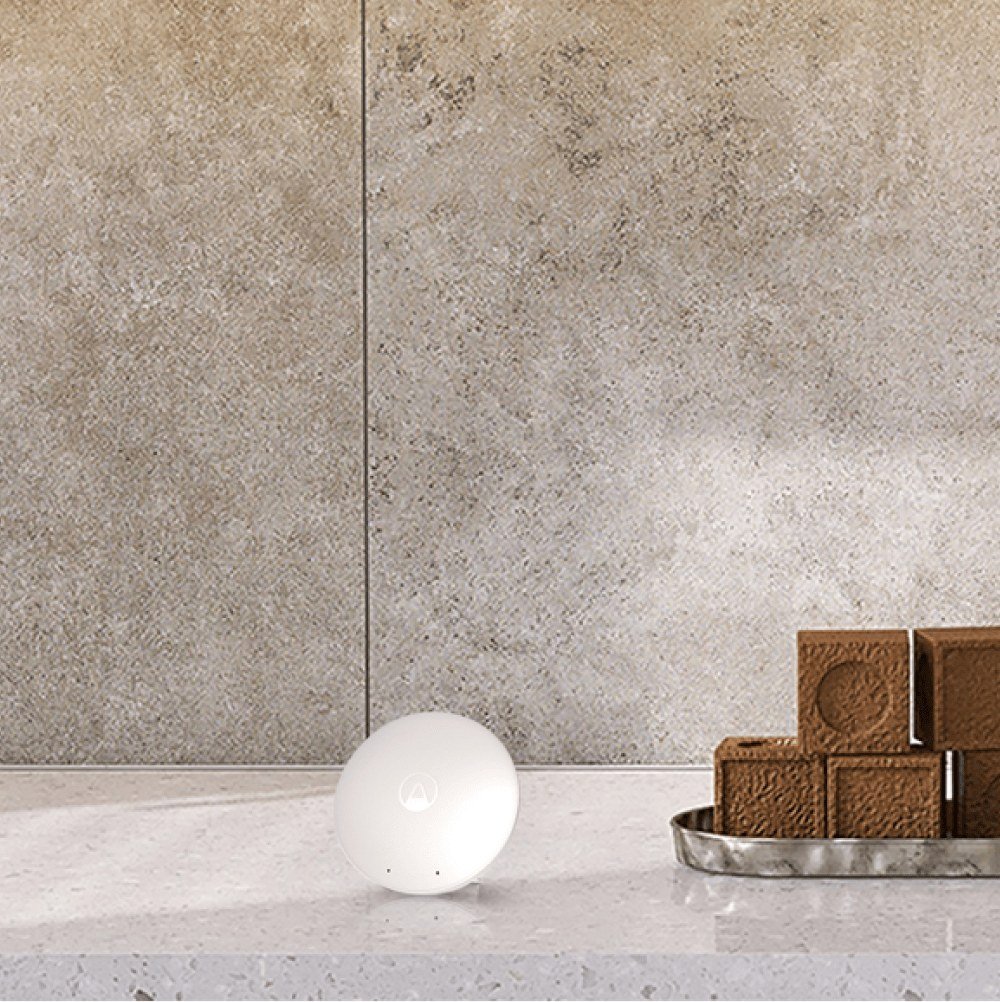
- MeasuresVOCs, temperature, humidity, plus a mold risk indicator
- DisplayRed, yellow and green glow light
- ConnectivityBluetooth or Airthings SmartLink
- PowerBattery, over 2 years on Bluetooth
- PlanNo subscription
The Wave Mini is a low-cost way to start tracking indoor air. It costs $89.99 on Airthings’ site.
It measures VOCs, temperature and humidity, and it uses those to show a mold risk indicator. A colored glow tells you at a glance if the air is fine.
It has no CO2, dust or radon sensor, and no screen with numbers, so you read the data in the app. The battery lasts over 2 years on Bluetooth.
What we like
- Low price
- Mold risk indicator
- Battery lasts over 2 years
- Wall or table mount
Watch out for
- No CO2 or PM2.5 sensor
- No number display
- Bluetooth range is limited
Best for: Bathrooms, basements and budget buyers.
Skip it if: You need CO2 or smoke readings.
Check price on Amazon Price range: $89.99
Side-by-side comparison
| Airthings View Plus | Aranet4 Home | IQAir AirVisual Pro | Qingping Air Monitor 2 | Airthings Wave Mini | |
|---|---|---|---|---|---|
| Best for | Best overall | Best CO2 monitor | Best for smoke and fine dust | Best value all-rounder | Best budget pick |
| Radon | Yes | No | No | No | No |
| PM2.5 | Yes | No | Yes | Yes | No |
| CO2 | Yes | Yes (NDIR) | Yes | Yes | No |
| Screen | E-ink | E-ink | Color | Color touch | Glow light only |
| Power | Battery or USB-C | Battery | Plug-in | USB-C | Battery |
| Price | $329.99 | $189 | $329.99 | See retailers | $89.99 |
| Our score | 9 | 8.8 | 8.6 | 8.4 | 8 |
How to choose an indoor air quality monitor
1. Decide which pollutants matter to you
PM2.5 sensors track smoke, cooking fumes and dust. CO2 sensors show when a room needs fresh air. VOC sensors spot fumes from cleaners, paint and new furniture. Only a few monitors also measure radon, which matters most in homes with basements or ground-floor rooms.
2. Look for a true NDIR CO2 sensor
Some cheap monitors estimate CO2 from VOC readings, which is often wrong. A real NDIR sensor, used by Aranet, Airthings, IQAir and Qingping, measures CO2 directly.
3. Choose how you want to read it
A clear screen lets anyone in the house check the air without a phone. App-only monitors keep a cleaner look but make you open your phone.
4. Check smart-home support
If you want an air purifier, fan or bathroom vent to turn on automatically, check that the monitor works with your system, such as Alexa, Google Home or IFTTT.
5. Place it where you spend time
Put the monitor at breathing height in the room you use most, such as a bedroom or living room. Keep it away from windows, vents and the stove, which can cause misleading spikes.
What the numbers mean
Every brand uses slightly different color scales, but these rough guides help you know when to act. Treat short spikes, such as while cooking, as normal. It is the long periods of high readings that matter.
- PM2.5: under about 12 µg/m³ is good. Above 35 µg/m³ for hours, run an air purifier and close windows if the air outside is smoky.
- CO2: outdoor air is about 420 ppm. Under 800 ppm indoors is good; above about 1,000 to 1,400 ppm, the room feels stuffy and needs fresh air.
- VOCs: watch for sudden jumps after cleaning, painting or cooking, and ventilate until levels drop.
- Humidity: aim for about 30% to 50%. Higher levels encourage mold and dust mites, and lower levels can dry out skin and sinuses.
Frequently asked questions
Are home air quality monitors accurate?
Good ones are accurate enough to show trends and tell you when to act. Particle and NDIR CO2 sensors are usually the most reliable. VOC sensors give relative readings, so focus on whether the number rises or falls rather than the exact value.
Can an air quality monitor detect carbon monoxide or gas leaks?
Most cannot, and the ones that do are not certified safety alarms. Always install UL-listed carbon monoxide alarms and smoke alarms, and call your gas company if you smell gas.
Where should I put an air quality monitor?
At breathing height, about 3 to 6 feet off the floor, in the room you use most. Keep it at least a few feet from windows, doors, vents, humidifiers and the stove.
Do I need a monitor if I have an air purifier?
A monitor shows whether your purifier is actually working and when to turn it up. Many people find they run their purifier more effectively once they can see the numbers.
Why is the CO2 high in my bedroom at night?
People breathe out CO2, so it builds up in a closed bedroom overnight. Opening a window or door slightly, or running ventilation, usually brings it down.
Do air quality monitors need a subscription?
None of our picks require one. Check before buying any monitor, as some brands charge for advanced features or long-term data.
The bottom line
For most homes, the Airthings View Plus is the best indoor air quality monitor, covering radon, fine dust, CO2 and VOCs in one device. Choose the Aranet4 HOME for accurate CO2 readings, the IQAir AirVisual Pro for smoke and fine dust, the Qingping Air Monitor 2 for the most readings for the money, or the Airthings Wave Mini on a budget.
More for cleaner air at home: see the best air purifiers for bedrooms, the best radon detector, or browse all Air Quality guides.
Sources
- U.S. EPA: introduction to indoor air quality
- Airthings: View Plus
- Aranet: Aranet4 HOME
- IQAir: AirVisual Pro
- Qingping: Air Monitor 2
- Airthings: Wave Mini
Featured photo: ‘Lab’ by Beige Alert, licensed under CC BY 2.0.