Best Water Softener (2026): 3 Picks for Hard Water
Last updated: November 9, 2026
Reader-supported: we may earn a commission when you buy through links on this page, at no extra cost to you. It never affects our rankings. Learn more.
Hard water is full of dissolved calcium and magnesium. It is not a health risk, but it leaves white crust on faucets and shower doors, spots on dishes, soap that will not lather, and scale that shortens the life of water heaters and dishwashers. A water softener removes those minerals before they reach your taps. The best water softener is sized for your household, uses salt and water efficiently and is easy to live with for years.
We compared the most popular softeners and salt-free conditioners on capacity, regeneration efficiency, controls, installation and long-term costs. Here are our picks for 2026.

Our top picks
| Water softener | Type | Score | Buy link |
|---|---|---|---|
| SpringWell SS Salt-Based SoftenerBest overall | Salt-based | 9 | Check price |
| SpringWell FutureSoft Salt-Free ConditionerBest salt-free option | Salt-free conditioner | 8.4 | Check price |
| Whirlpool WHES40 40,000-Grain SoftenerBest budget pick | Salt-based | 8.2 | Check price |
The best water softeners, reviewed
SpringWell SS Salt-Based Softener

- TypeSalt-based ion exchange
- SizesCore (SS1), Pro (SS4) and Max (SS+), for 1 to 7+ bathrooms
- Flow11 GPM on the SS1; up to 20 GPM
- EfficiencySmart regeneration saves salt and water
- WarrantyLifetime warranty, 6-month money-back guarantee
SpringWell’s salt-based softener is the system we would choose for most homes with hard water. It removes calcium and magnesium for true soft water, and its smart regeneration saves salt and water.
It comes in sizes for 1 to 7+ bathrooms, with up to 20 GPM of flow. SpringWell backs it with a lifetime warranty, a 6-month money-back guarantee and free US shipping. It costs more up front than big-box softeners, and like any salt softener it needs salt refills and a drain line.
What we like
- Sized for your household
- Smart regeneration saves salt
- Lifetime warranty
- 6-month money-back guarantee
Watch out for
- Higher up-front cost
- Needs salt refills
- Professional install recommended
Best for: Most homes with moderate to very hard water.
Skip it if: Your area bans salt-based softeners.
Check price on Amazon Price range: See SpringWell
SpringWell FutureSoft Salt-Free Conditioner
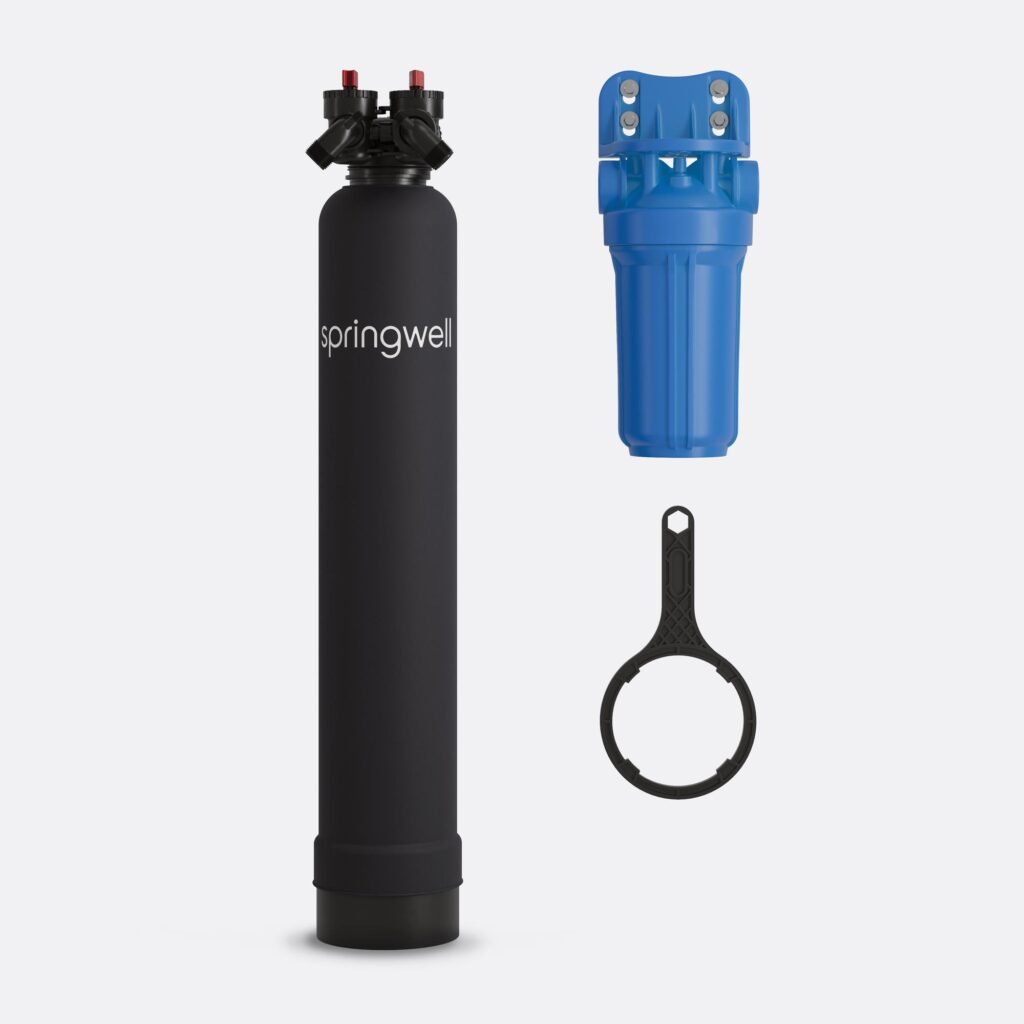
- TypeSalt-based ion exchange
- Capacity40,000 grains; removes up to 125 gpg hardness and 10 ppm clear-water iron
- ControlsDemand Regeneration with a tank light for salt level
- PlumbingHigh-flow valve fits plumbing up to 1 1/4 inches
- WarrantyCan be extended to 5 years with cleanser purchase
Whirlpool’s WHES40 is an affordable softener sold at home improvement stores. Whirlpool says it removes up to 125 grains per gallon of hardness and 10 ppm of clear-water iron, and its Demand Regeneration only regenerates when you need it.
A tank light shows the salt level so you know when to add more, and the high-flow valve fits plumbing up to 1 1/4 inches. It is less flexible than premium systems, and very hard water or big families may need a larger model.
What we like
- No salt, no wastewater
- No added sodium
- Little maintenance
- Allowed where softeners are restricted
Watch out for
- Does not truly soften water
- Some spotting may remain
- Less effective on very hard water
Best for: Scale prevention where salt softeners are not allowed or wanted.
Skip it if: You want truly soft water for skin and dishes.
Check price on Amazon Price range: See retailers
Whirlpool WHES40 40,000-Grain Softener

- TypeSalt-based ion exchange, single cabinet
- Capacity40,000 grains; handles up to 125 gpg hardness and 10 ppm clear-water iron
- ControlsDemand-initiated regeneration with salt-level light
- Salt storageAbout 200 lb
- InstallDIY possible; sold at big-box stores
Whirlpool's WHES40 is an affordable, compact all-in-one softener sold at home improvement stores. Whirlpool rates it to handle up to 125 grains per gallon of hardness and 10 ppm of clear-water iron, and it regenerates based on demand, so it only uses salt when needed. A light shows when the salt is low. The single-cabinet design is easy to install and maintain. It is less flexible than premium systems, and very hard water or big families may need a larger unit.
What we like
- Low price
- Compact all-in-one cabinet
- Demand regeneration
- Easy to find at stores
Watch out for
- Basic controls, no app
- Less capacity than larger units
- Longer warranty requires using Whirlpool's cleaner
Best for: Small households on a budget.
Skip it if: You have a large family or very hard water.
Check price on Amazon Price range: See retailers
Side-by-side comparison
| SpringWell SS Salt-Based Softener | SpringWell FutureSoft Salt-Free Conditioner | Whirlpool WHES40 40,000-Grain Softener | |
|---|---|---|---|
| Best for | Best overall | Best salt-free option | Best budget pick |
| Type | Salt-based | Salt-free | Salt-based |
| Truly softens water | Yes | No (prevents scale) | Yes |
| Uses salt | Yes | No | Yes |
| DIY install | Not ideal | Not ideal | Yes |
| Price | See SpringWell | See retailers | See retailers |
| Our score | 9 | 8.4 | 8.2 |
How to choose a water softener
1. Measure your hardness
Use a hardness test strip or your utility’s water report. Hardness is often given in grains per gallon (gpg); above about 7 gpg is considered hard.
2. Size it correctly
Multiply your hardness by your household’s daily water use (about 75 to 80 gallons per person) to find the grains removed per day. Choose a softener that regenerates about once a week at that rate.
3. Choose metered regeneration
Metered or demand-based valves regenerate only when needed, saving salt and water compared with timer-based models.
4. Decide on salt or salt-free
Salt-based softeners truly remove hardness. Salt-free conditioners prevent scale without salt or wastewater but leave minerals in the water.
5. Plan the installation
Softeners need a drain, an outlet (for most) and space near the main water line. Install a bypass valve, and consider leaving an unsoftened tap for drinking if you prefer.
Living with a water softener
A softener needs little attention once it is set up, but a few habits keep it working well:
- Check the salt level monthly and keep the brine tank about a quarter to half full.
- Use clean, high-purity salt pellets to reduce buildup in the brine tank.
- If you are on a low-sodium diet, ask your doctor, and consider potassium chloride instead of salt or a drinking-water filter.
- Pair a softener with a carbon filter if you also want to reduce chlorine taste and odor.
Frequently asked questions
Is hard water bad for my health?
No. Hard water is generally considered safe to drink, and the calcium and magnesium can even contribute to your diet. The problems are scale, spotting and soap scum.
Do water softeners add salt to water?
They add a small amount of sodium, depending on how hard your water is. People on low-sodium diets can use potassium chloride or drink from a separate filtered tap.
Do salt-free water softeners work?
They help prevent scale buildup in pipes and appliances, but they do not remove hardness minerals, so water does not feel soft and some spotting can remain.
How long do water softeners last?
A good salt-based softener often lasts 10 to 15 years or more. The resin and valve parts can be serviced or replaced.
Can I install a water softener myself?
Handy owners can install many systems, especially big-box units. Larger systems are best installed by a plumber, and some areas require one.
Will a water softener remove contaminants?
Softeners mainly remove hardness and some iron. For chlorine, lead or other contaminants, add a filter designed for those.
The bottom line
For most homes, the SpringWell SS is the best water softener, with smart regeneration and a lifetime warranty. Choose the SpringWell FutureSoft for salt-free scale prevention, or the Whirlpool WHES40 on a budget.
More for better water: see the best whole house water filter, the best shower filter, or browse all Water Filtration guides.
Sources
- U.S. Geological Survey: hardness of water
- U.S. EPA: Consumer Confidence Reports
- SpringWell: Salt Based Water Softener System
- SpringWell: Salt-Free Water Conditioner (FutureSoft)
- Whirlpool: WHES40 40,000 Grain Water Softener
Featured photo: ‘Water treatment system’ by bfishadow, licensed under CC BY 2.0.